
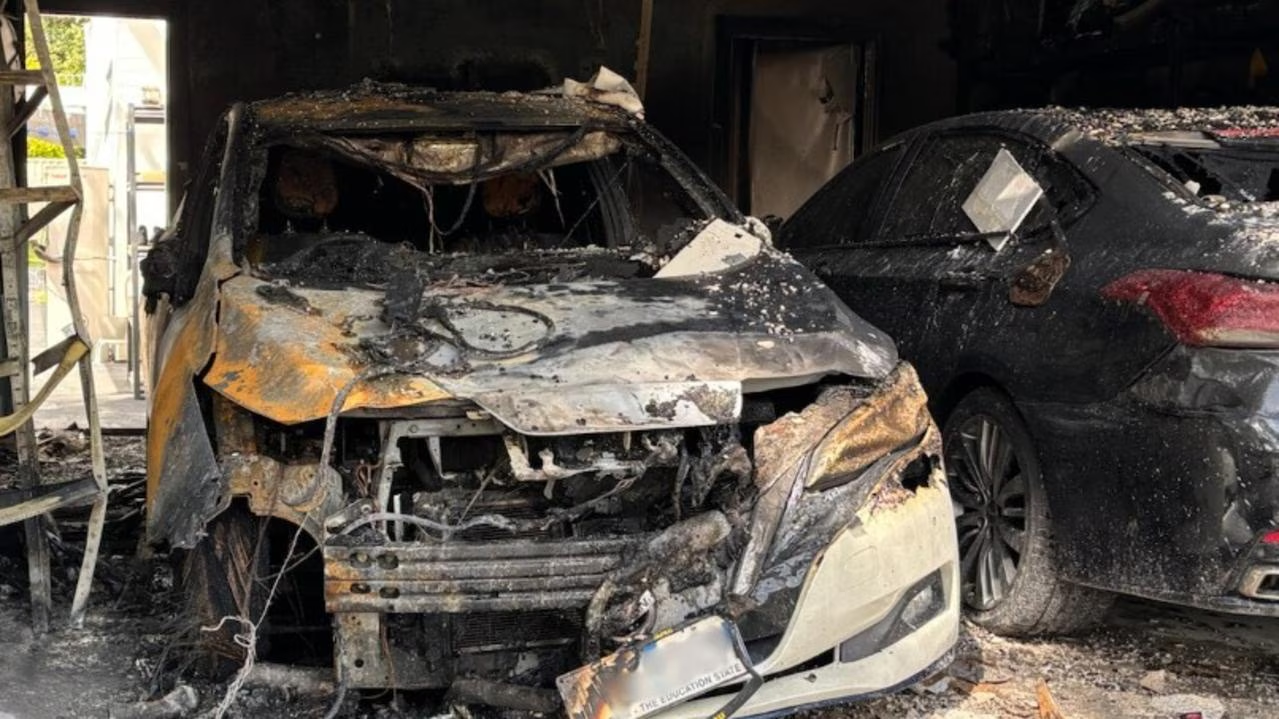
Australian electric vehicle owners risk losing their houses to dodgy EV chargers that use AI to bypass safety limits.
Scott Nargar, senior manager of future mobility and government relations at Hyundai Australia, said EV owners must be wary of devices with AI-enhanced software capable of hacking past vehicle safety systems intended to protect batteries.
Nargar said some of the chargers are being used by thrifty owners to sell electricity back to the grid during peak periods, a procedure that could result in catastrophic damage not covered by vehicle manufacturer warranties or home insurance.
MORE: EV drivers offered lucrative side hustle
In the same way that people with solar panels on their house can sell energy back to the grid, EV owners can use smart chargers with a “vehicle to grid” capability to draw excess energy of their vehicle – even if the car was never designed to do so.
“We’ve witnessed this across a number of brands, where they’re achieving a discharge with cars that were never designed for a discharge, which means they’re going into the system, they’re hacking the car systems,” Nargar said.
“The vehicle doesn’t know it’s in a discharge state, and in fact, in some of the vehicles I’ve seen, the car actually thinks it’s charging, and it’s certainly not in a ‘vehicle to grid’ discharge session which is factory backed and factory supported.
MORE: Don’t buy an EV if you live here
“So there’s concerns about warranties, there’s concern about insurances with homes, concerns about what happens if a vehicle needs to stop a discharge session, and in a lot of these cases the car has got no control of that.”
The safety limits in electric cars are intended to prevent batteries and other hardware from overheating. Bypassing them could prove catastrophic.
“The car doesn’t know it’s doing it, so it can’t stop it,” Nargar said. ”It can’t control it if it does sense something’s happening with its battery, that needs to limit the flow of energy out or stop the flow of energy out.”
MORE: Calls for bigger fines for large vehicle drivers
Vehicle to grid technology promises to put money back into an owner’s pocket.
AusGrid spokesman Rob Amphlett said in August 2025 that it “transforms EVs into more than just a transportation tool – for customers that are interested, they can become income-generating assets and energy-management systems, enhancing the overall value and practicality of owning an EV.”
“Customers can use their EV batteries to sell excess energy back to the grid during peak times and recharge at off-peak rates, creating an additional source of income,” he said.
But not all cars are designed to be used in that manner.
MORE: Ferrari shocks with radical new EV
Amber Energy is running a vehicle-to-grid trial in Australia that experiments with people drawing energy out of their car’s battery to sell back to the grid in peak times.
BYD has backed the trial by expanding the scope of its warranty for owners of the Atto 3 electric car.
One participant, a South Australian named Sam, acknowledged that the process does cause wear and tear on the battery.
“If I had to buy a new EV, looking for permissive vehicle-to-grid conditions would be a big part of the deal for me,” he said.
“This is now a must-have feature, not just a nice-to-have.”
The solar hardware, home battery and electronic controllers hardware required to make vehicle-to-grid charging work cost more than $20,000 once installed.
But drivers can make some of that back by selling energy to the grid in periods of peak volatility, and Amber Energy claims one customer made $700 in an afternoon during a period of unusually volatile demand.
Amber Energy co-chief executive Dan Adams said “if we can automate home batteries and EVs to charge at those cheap renewable times, and discharge at the times the grid needs power, we can meet a very large share of the battery storage requirements for the entire energy transition”. “Households are really going to be at the centre of the transition, making this happen.”
But the devil may be in the details.
Hyundai’s Scott Nargar said testing has shown some chargers sold in Australia have used machine learning, or artificial intelligence, to find a way around security features intended to limit the way cars can be used.
“In some of the test labs we’ve seen the charger get plugged into the car 10 plus times,” Nargar said.
“The first couple of times it was rejected and the car shut off straight away. Then I get 10 seconds out of the car, then 20 seconds, and three minutes, and eventually it hacks itself around the car systems and enables a discharge for vehicles that were never designed to discharge and is not supported by the manufacturers. ”Worst case scenario, you could take a battery to absolute zero and kill the battery, which would be quite a bit of an expense for the consumer.”
AI is increasingly common in modern electrical infrastructure.
Electric vehicle hardware supplier EVSE states on its website that “AI and Machine Learning are becoming central to the evolution of EV charging networks”.
“As Australia’s electric vehicle landscape continues to expand, smarter, data-driven charging solutions will be essential to meeting future energy demands and delivering reliable, efficient charging experiences.”

Chargelab claims the “industry’s first proactive AI fixes problems with EV chargers before you notice them”, and Pulse Energy states that “AI-powered EV charging software is at the heart of the transition to electrified transportation”.
The IT industry has become increasingly aware of the vulnerability held by electric vehicle chargers.
PC Mag reported on “the EV charger hack that can burn down your house” in August 2025, following a cyber security conference that exposed shortcomings in home equipment.
More recently, expert hackers were invited to probe charging systems at the Pwn2Own Automotive contest in Japan, where sponsors put up more than $US1 million ($1.42m) in prize money to people who could exploit weaknesses in modern cars.
Hyundai Australia has lobbied the government to adopt a stricter charging standard, ISO 15118-20, a vehicle and vehicle to grid communication interface that “sets out communication requirements for automatic connection device and information services”, as chargers that comply with a simpler standard may damage vehicles, charging infrastructure and homes.
“These charges on the market now can be purchased today,” Nargar said.
“Everyone’s rushing to a start line that hasn’t been established yet. In some cases, people are running past it.”
Click Here For The Original Source.
