
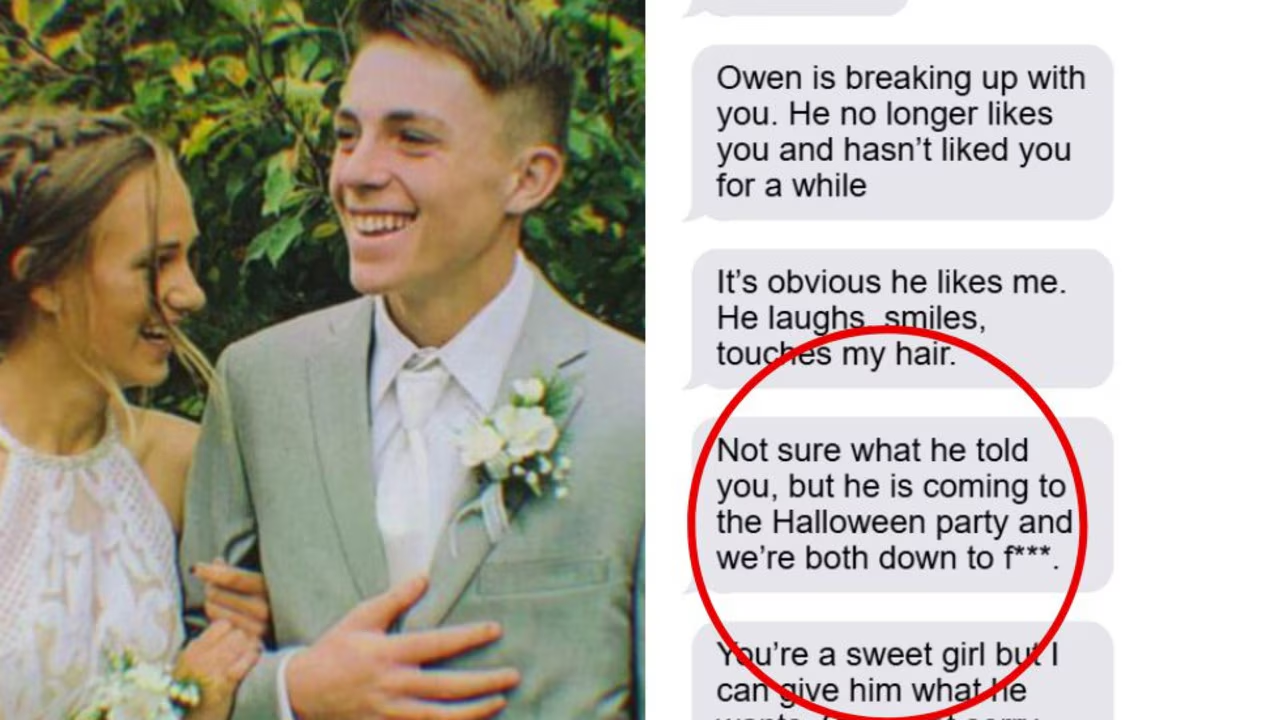
It all began with a text message two weeks before a Halloween party in a small town in the US — and ended with irreparable damage to an entire community.
Lauryn Licari, a Beal City school student, met boyfriend Owen McKenny when they were just 12 years old. The couple attended the same school in Michigan, which catered from kindergarten to Year 12.
A year into their relationship, two weeks before a Halloween party Ms Licari wasn’t invited to, a group chat was created and a string of anonymous messages began to flood in.
“Hi Lauryn, Owen is breaking up with you. He no longer likes you and hasn’t liked you for a while,” the texts read.
“It’s obvious he likes me. He laughs, smiles, touches my hair. Not sure what he told you, but he is coming to the Halloween party and we’re both down to f***.
“You’re a sweet girl but I can give him what he wants. Sorry not sorry.”
The pair, confused, tried to find out who sent the texts. Before they were able to do so, the texts stops for 11 months.
Netflix documentary Unknown Number: The High School Catfish, which hit the streaming platform in Australia on August 29, explores the disgusting text message abuse endured by the high school students and the damage cyber-bullying can have.
Almost a year after the first messages, the couple began to receive new strings of anonymous texts.
“How’s the happy couple? Preparing for the end of the ‘golden relationship,” a new set of texts began.
“Owen loves me, and I will always be the girl he loves. He will be with me while your lonely, ugly a** is alone.”
Over the course of 22 months, the messages progressed. They became more sexual in nature, discussing sex acts that Mr McKenny and the sender were allegedly doing behind Ms Licari’s back, and eventually threatening. They encouraged Ms Licari to take her own life.
“U are worthless n mean nothing,” one text message read.
Another said: “Kill yourself now b***h.”
Appearing in the documentary, Mr McKenny said he and Ms Licari were fine at first, but the text messages made his girlfriend question herself and the relationship.
Eventually Mr McKenny FaceTimed his girlfriend and said maybe if they gave the culprit what they wanted — a break up — then they would both be left alone.
However it had the opposite effect.
Eventually, Mr McKenny confided in his parents about what was happening. They were disturbed and, along with Ms Licari’s parents, went down to the school to demand not only answers but help catching the person harassing their children.
The investigation
At first there were concerns that Ms Licari herself was sending the messages in a bid to get attention, but that was quickly dismissed.
Sheriff Mike Main questioned fellow students such as Khloe Wilson, as clues in the messages indicated it could be her.
Despite a search of her phone ultimately revealing she had nothing to do with the cyber-bullying, this didn’t stop people in the small town believing she was behind it.
The texter also began to use Ms Wilson as a scape goat, which prompted concerns that someone was doing it all to get back at her.
That, plus photos sent from the McKenny’s Christmas Day activities, made police look at Mr McKenny’s cousin Adrianna. She claimed to have been bullied by Ms Wilson and her friends.
Adrianna was also cleared by police.
Then, Mr McKenny began to date someone new from a town he had visited for a sporting tournament. Soon, that young woman’s mum also began to receive similar text messages.
FBI involvement
His mother, Jill, noticed a change in her son and begged police to put more time and energy into finding out who was responsible for harassing him. Eventually, Sheriff Main shared everything he knew with the FBI. Bradley Peters sent out search warrants in a bid to get closer to the truth. An IP address turned up a phone number that was connected to Ms Licari’s mother Kendra, who had an IT background.
Sheriff Main and a detective issued a search warrant for the Licari home to seize the mum’s phones and laptop. At first, she denied any involvement. However, when probed further, she eventually confessed.
‘It didn’t start that way,” she said, according to bodycam footage used in the documentary.
Sheriff Main then told Ms Licari everything.
The teenager sat there, stunned at the news her mother had been psychologically targeting her. Her mother tried to hug and comfort her daughter as she began to cry.
The fall out
Licari eventually pleaded guilty to two counts of stalking a minor and sentenced to 19 months in prison. In court she sobbed as she apologised.
Mr McKenny’s mother Jill said she felt “disgusted and betrayed”. She and Licari had worked tirelessly together to find the person responsible for terrorising their children — only to find out that she was behind it all along.
Meanwhile Bill Chillman, the school district’s superintendent, weighed in with his thoughts about the shocking situation.
“I think it was a cyber Munchausen’s case,” he said in the documentary.
“She wanted her daughter to need her in such a way that she was willing to hurt her, and this is the way that she chose to do that vs. physically trying to make her ill, which is typical Munchausen’s behaviour.”
Licari’s defence
Licari was released on parole on August 8, 2024. In the documentary, she denied that she was the one who began the text messages, although her daughter expressed doubts about this. She said she began to send them in the hopes that the children would reveal who they thought the culprit was, so she could help.
“Every single one of us makes mistakes. Not a single one of us has lived a perfectly life. And, realistically, a lot of us have probably broke the law at some point or another and not get caught,” Licari said.
“I’m sure people have drove drunk and not got caught. But again, if you get caught, you’re in the same situation I’m in but for a different thing. I do feel people lose sight of it.
“I know to some I am a headline. I am a villain. I am a bad mum, whatever. But that’s because they know one little piece of my story. They don’t know the whole story.”
Eventually, Licari claimed in the documentary that seeing her daughter with a boyfriend — and growing up — made her want to protect her daughter. She said as her daughter became a teenager, it brought up a lot of her own trauma that she hadn’t dealt with.
Mr McKenny and Ms Licari no longer speak as a result of what her mother did. Ms Licari isn’t currently allowed to see her mother. However, she said she hoped that they could one day rebuild their relationship.
“I think I wanna trust her now but I don’t think I can,” Ms Licari, who has hopes of studying criminology at university, said in the documentary.
“I love her more than anything.”
Documentary maker weighs in
Skye Borgman, who directed the doco, said the film was intended to highlight the impact that cyber-bullying can have on families. Ms Borgman added that Licari’s answers seemed rehearsed.
“I think she’s got a little bit of revisionist history. I think some of what she says is the truth. I think some of what she says isn’t truthful, where those two intersect is constantly changing,” she told TODAY.com.
Cyber-bullying in Australia
Cyber-bullying can take many forms, whether that is hateful comments on a post, excluding someone or tricking them with fake accounts. It also includes image-based abuse, such as faked explicit photos.
In Australia, one in five people between the ages of eight and 17 have been cyberbullied, according to the eSafety Commission. One in five have also admitted to being the perpetrators of cyber-bullying.
People are encouraged to block and report bullies to the app and the eSafety Commission.
