
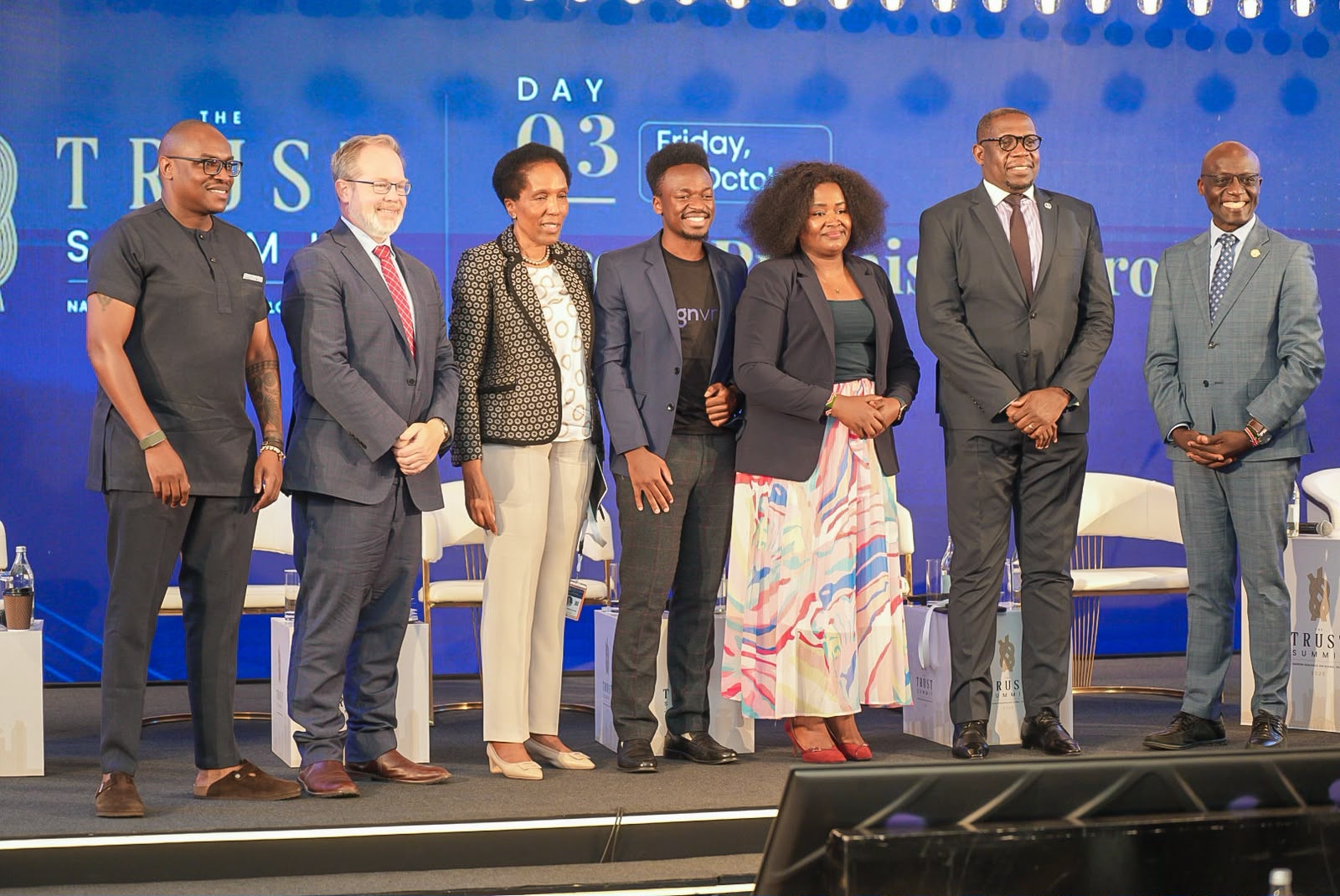
At the recent Trust Summit, tech experts urged parents to keep kids under 13 off social media, warning that protecting young users requires strict parental vigilance, responsible tech design and stronger accountability from platform companies.
During day three’s panel on “Africa’s Digital Futures”, techies argued that Artificial Intelligence (AI), social media algorithms and digital platforms will smoothen balance of social media in society, while shaping information consumption and public trust.
Experts pointed to growing debate over age restrictions and children’s online safety, including policy discussions in France, the United Kingdom and Norway, and urged African parents, policymakers, educators and technology companies to give greater priority to protecting children from potential online harm.
“Platforms do have a responsibility to vet and verify and let users know what is real and what has been artificially created,” Charles Murito, Regional Director for Government Affairs and Public Policy for Sub-Saharan Africa at Google, said, noting that trust was particularly important in the AI age.
Mr. Murito’s remarks highlight the growing challenge of distinguishing authentic information from AI-generated content, particularly as synthetic images, videos, and other forms of digital media become increasingly sophisticated. The discussion placed child safety at the center of a broader conversation about building a digital environment that promotes trust, safeguards vulnerable users, and ensures technology serves the public interest.
Ambassador Philip Thigo, Kenya’s Special Envoy on Technology, observed that technology has become an integral part of everyday life, fundamentally changing how people access and consume news and information. He emphasized the need for families and institutions to adapt to a digital landscape where children are exposed to information, online interactions, and technology-driven experiences from an increasingly young age.
Mercy Ndegwa of Meta pushed the needle further saying that platforms are designed to facilitate social connections through technology, offering users curated experiences rather than simply supplying content. This perspective underscores the role of platform design in shaping what users encounter online and how they interact with others, raising critical questions about the responsibilities of technology companies toward younger audiences.
The panel of experts noted that protecting children online cannot rest solely on parents; technology companies, governments, schools, and civil institutions must also play their part in ensuring digital environments are safer, more transparent, and age-appropriate.
The conversation also questioned the ability of existing governance systems to keep pace with rapid technological change. Dr. Katherine Getao, who is an independent consultant in cyber diplomacy, cyber hygiene, and cybersecurity, and former CEO of Kenya’s ICT Authority, said the world is attempting to govern the 21st century using 20th-century knowledge.
Her observation points to an urgent need for more responsive regulatory frameworks, stronger digital literacy, and institutions capable of addressing the emerging risks associated with artificial intelligence and online platforms.
The framework begins by equipping young people with the skills to navigate the digital world responsibly, safely, and with confidence
Integrity of info
Beyond child safety, the sumit examined the relationship between digital platforms, journalism, and the integrity of information in an era of algorithm-driven content and AI-generated media.
According to Geoffrey Odundo, Group Managing Director and CEO of Nation Media Group, source of information remains fundamental to determining its credibility.
“Every piece of content has a source. Whatever you read and consume comes from somewhere,” Mr. Odundo said, adding that truth remains central to the media’s responsibility, even as competition for speed and audience attention intensifies.
“The currency for us is in the truth,” he emphasized, stating that journalism must prioritize accuracy and credibility over the pressure to publish first.
Odundo also acknowledged that the media faces a continuous challenge in balancing the demand for speed with its obligation to verify information before publication.
The discussion emphasized media literacy, source verification, and responsible sharing to combat misinformation. It concluded by highlighting the importance of media literacy, source verification, and responsible content distribution in helping audiences distinguish credible reporting from misinformation and manipulated digital content.
Rethinking education and inclusive digital access also came up at the summit, with Dr. Jason Lane, Senior Advisor for Strategy and Innovation in the Office of the President at the University of Illinois System and Professor of Educational Policy, Organization and Leadership, developing modern technologies by universities is tough but possible.
Dr. lane argued that education must evolve to prepare learners to engage with technology, solve complex problems and respond to the changing demands of society.
Elly Savatia, founder of Signvrse and Terp 360, called for accessibility to be embedded into the design of digital systems rather than treated as an afterthought.
“We need to ensure the world is accessible by design. There are forms of disabilities that are invisible that need to be considered,” Savatia said.
He added that personal experiences with institutions shape whether people consider them trustworthy, highlighting the relationship between inclusion, service delivery and public confidence.
——————————————————–
Click Here For The Original Source.
