
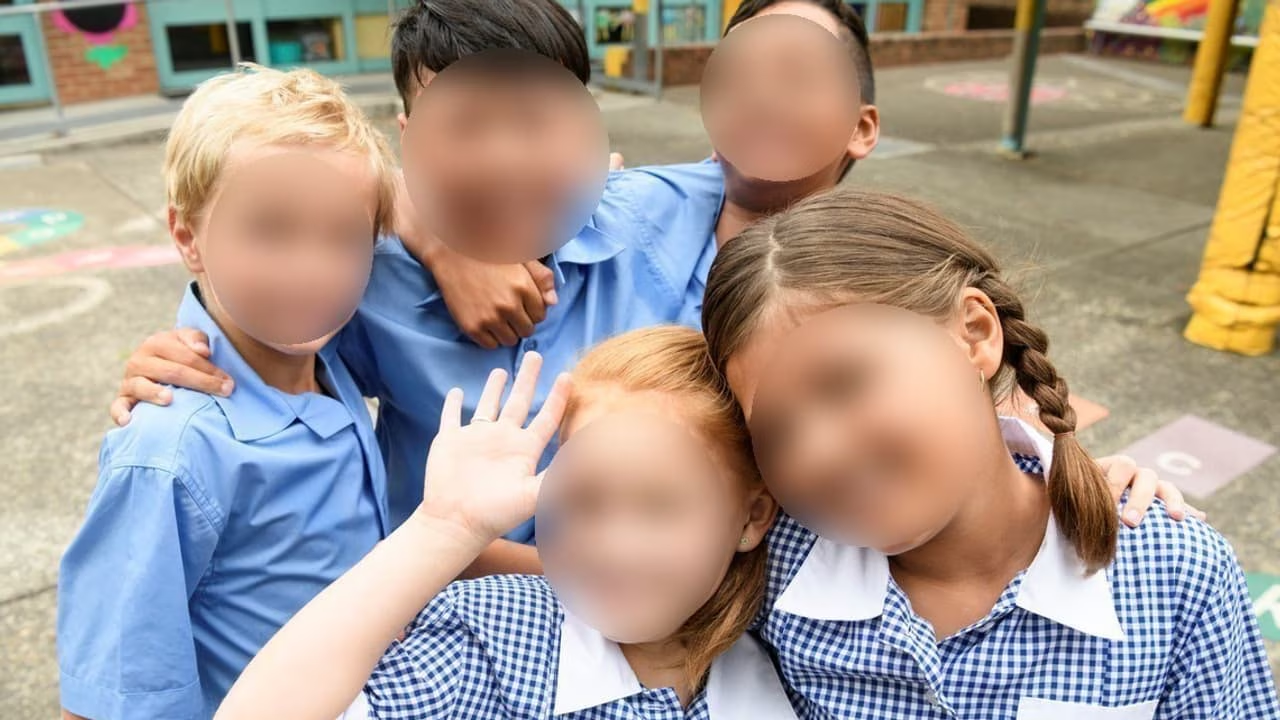
Chloe has been held aginst the wall with her feet off the ground so she couldn’t breathe, stalked, strangled and had her daughter kidnapped, allegedly all at the hands of her ex-partner.But while she has a domestic violence protection order in place, a common school practice is placing them in danger.As the hazards of AI increase, a rising number of parents have raised concerns about the publicly available and identifiable information being shared online by schools. Chloe doesn’t allow pictures of her child to be published on the school’s social media, yet the school’s advertising means they can be easily tracked. When her daughter went on a school camp last year, live updates were posted on a public Facebook page, including the location, activities they were doing that day as well as the times they would be leaving and arriving at school.“I was absolutely gobsmacked. I was shocked because my ex does know the school that she goes to and also the grade that she’s in. He could easily go and have a look at that and see where she was at that time,” Chloe told news.com.au.“It’s about 100 kids to a ratio of maybe four teachers and it’s quite easy for someone to look at that and go and take my child.”But despite raising her concerns, Chloe said she was dismissed by both the school and the Queensland Department of Education, and now she is worried as another camp looms.“The school’s excuse was that they were advertising and it felt like they chose advertising over child safety, which really hurt,” she added.In correspondence seen by news.com.au, Chloe was told by the QLD Department of Education there was no evidence the school was breaching any lawful order by advertising when a school camp is being conducted. “This information does not mention you personally or any details regarding you. It would also require another party know what school your daughter attends,” the email read.The tone deaf note also spoke about how family law-related disputes should not happen at schools, as they disrupt the good order and management of the campus. “Schools are meant to promote a safe, secure learning and teaching environment for students and staff,” it read.“They are not the place to resolve matters that can more properly be resolved privately or in the Family Court.”A QLD Department of Education spokesperson said it could not comment on specific matters for privacy reasons, but that there was no higher priority for the department than the safety and wellbeing of students.But Chloe is concerned that children’s safety isn’t being taken seriously and it’s only going to get worse with the rise of AI, as a news.com.au investigation looks into the widespread human impacts that artificial intelligence is already having on our nation after just a few short years.Do you have a story? Contact sarah.sharples@news.com.auPublic pages scraped by botsKrissy Rabino started a petition for all NSW schools to limit posting children’s faces and personally identifiable information. She works as a software engineer, and was alarmed at the lack of online safety measures for students.The mum has seen kids’ faces, locations, school uniforms, birthdays, hobbies and interests posted across different schools’ public forums, which leave children vulnerable to predators.Then there’s the heavy use of AI manipulation tools like the Nudify app, which require zero technical skills.“If it’s an innocent photo of someone, like a kid lying down, or even looking up from down below, there are just many ways that people can manipulate innocent images into sexualised data or using it for child sexual abuse material,” she said.“This isn’t nowadays just one person going in browsing and downloading a photo and then manipulating it. These public pages can be scraped by bots programmed to do this at scale.“Once things are posted online, they have no control over what happens to their content once it’s there.”She said just last month the NSW Education Department shared a post about a student who saved her friend from drowning in a dam on a property, which included her first name, the school she attended and her full face pictured in school uniform.“They’ve done it in a way that … celebrated a story about safety, but then shared it in the most unsafe way for this little girl,” she said.“The Department of Education should be putting kids’ safety first and foremost as a priority, but obviously they’ve chosen, again, promotion and engagement over safety.”Ms Rabino has also heard of instances where kids, who don’t have consent to be posted on social media are barred from participating in a school activity, due to it being recorded.“This is my belief that parents are feeling forced to choose between the digital safety of their children and the psychological safety,” she said.A NSW Department of Education spokesperson did not respond to questions regarding whether social media policies should change or about the Facebook post that identified the child who had saved a friend from drowning.“Schools across all sectors use social media to connect with families and their local community,” they said.“This is an issue facing all schools and organisations that work with young people. The department continually reviews its guidance in line with emerging evidence and the changing digital landscape.”Another concerned parent is Agnes Durlik, who has tried to advocate for change at her daughter’s school, but has been faced with blank stares.“There is almost a disbelief or a statement of it won’t happen to us, which seems to give the school permission to keep doing what they’re doing,” she said.“Even when presenting situations from the States where young adolescent children have committed suicide because a deepfake of them in a pornographic augmentation was disclosed to peers – that kind of an example still doesn’t seem to resonate with educators here locally.”The 45-year-old believes the argument that parents can opt their children out of being posted online was “half baked” and exposed them to exclusion and bullying.“I think it’s going to take courage and strength be that a principal at a local level or a policymaker at a board level or even at a ministry level to say we need to stop and pause and not continue doing what we’re doing,” she added.‘Sadistic online exploitation’Colm Gannon is the CEO of ICMEC Australia, which leads cross-sector advocacy on child protection and AI safety and convenes the SaferAI for Children Coalition.He said posts from schools can be turned into “a moment of harm or continuous moment of harm and we know this is happening all over the world”.“Because we have seen this time and time again used for sadistic online exploitation, the likes of sexual extortion, cyber-bullying and it’s not just the offenders that are online going to these schools (for pictures and videos),” he said.“It’s also students and peer-on-peer abuse that’s actually taking place as a result of the moments of celebration within the school environment.” Mr Gannon said education was key, but there was also a need for intentional decision making.“Not just by asking the parents to sign a form or the guardians to sign the form if they want their kids’ pictures to be displayed or not,” he said. “It should be standard that those moments are kept in a secure environment and that they’re not used as an advertisement tool.” How are some Australian’s leading change on social media sharing?Some Australian schools are leading the way.St Hilda’s Anglican School For Girls in Perth appears to be the first in the country to announce a change to its social media policy. It told parents, staff and students from kindergarten to Year 12 it would remove identifiable images of students from public social media channels due to photo manipulation and deepfake technology.Images would instead feature side profiles, silhouettes, backs of heads, distant group shots, creative filters, or approved stock photography.Principal Fiona Johnston told news.com.au the strategy was not a reaction to a specific incident, but a proactive move. Staff gave a standing ovation when the decision was announced.There had been zero pushback from parents, with the new policy attracting new enrolments, she said.The move was prompted by the introduction of Australia’s under 16 social media ban.“It really raised questions around why schools would continue to publish identifiable images of children on platforms where young children shouldn’t even be accessing or using it,” she said.There’s been a surprising appetite both in Australia and globally from other schools to learn about St Hildas’ decision.“Independent schools from Canada, New Zealand, the US, the UK, South East Asia were asking me for copies of our policies … so we completely underestimated the impact that you know a girls school in Perth, Australia could have in this space.”Reacting to emerging risks like smart glassesBut she said the move is not without its challenges including archiving of historical photos, which is more difficult on some platforms, communicating change and investing in a secure gallery system. She said schools need to map out a plan to go faceless online for students.“Photographers now need to capture images from two different perspectives,” she said. “We’ve got both our public social media and then we’ve got our secure parent gallery. So this often means taking more photographs overall and planning different compositions for the same event.”Schools that continue to ignore their responsibility in this space are “quite neglectful”, she believes.“I would be very surprised in the next 12 months if we didn’t see a significant shift in this space,” she said.As new tech emerges such as smart glasses, St Hilda’s feels more prepared to respond quickly too, she said, with a decision made to ban them on campus. More schools follow the social media trendAnother Australian independent school, Brisbane’s Brigidine College, which is a Years 5-12 girls’ school, announced in February it was restricting recognisable photos on social media channels.Its channels focus on adult-facing content including college news, leadership, wellbeing and recruitment, staff stories, community partnerships, major events and key dates.In August, Jannali East Public School in Sydney’s south announced it was “going faceless” on social media. The trial will play out for the rest of the year, following new guidance from the eSafety Commissioner about how AI tools are being used to misuse photos taken from school social media pages. “We want our school to be known as a school that takes online safety seriously, not just for our students, but as an example for the whole community,” the school wrote on Instagram.How is the education sector responding?News.com.au asked the education sector how it was responding to the threats of AI and student identities.Chief executive of Independent Schools NSW Margery Evans said the rapid development of artificial intelligence is creating new and complex privacy and child safety considerations for schools, particularly in relation to the use and misuse of student images.The organisation represents more than 250,000 students or one in five NSW students.“Independent Schools NSW supports our sector’s 580 schools and campuses to consider these matters as child safety, privacy and governance issues,” she said.“We recommend that schools apply an AI-risk lens to their use of student images and ensure that appropriate consent and governance processes are in place to minimise the likelihood of misuse.”Scott Ryan, the executive director of the National Catholic Education Commission, said AI has changed the risk landscape for student images. “Schools are considering how best to share and celebrate student life in ways that reflect their local communities, while ensuring student safety is paramount,” he said.“Catholic education supports a risk-based approach, informed by advice from the eSafety Commissioner which helps schools and systems make decisions appropriate to the need, circumstances and expectations of their communities while prioritising student safety.”A federal education department spokesperson said the Australian Government takes student wellbeing and online safety very seriously and is committed to supporting safe, respectful and inclusive learning environments.“Advice from the eSafety Commissioner promotes a risk-based approach to image sharing and encourages schools and education authorities to review their practices and consider whether publicly shared images are necessary,” they said.“If a school posts a photo or video of a student online without permission, parents and carers can contact the school or relevant state, territory or non-government education authority to raise their concerns.”While the Australian Government plays a leadership role in national priorities for school education and provides funding to school education, state and territory governments and non-government education authorities are responsible for managing schools, they added.*Name changed for safety reasonssarah.sharples@news.com.au
Source link
——————————————————–
Click Here For The Original Source.
