
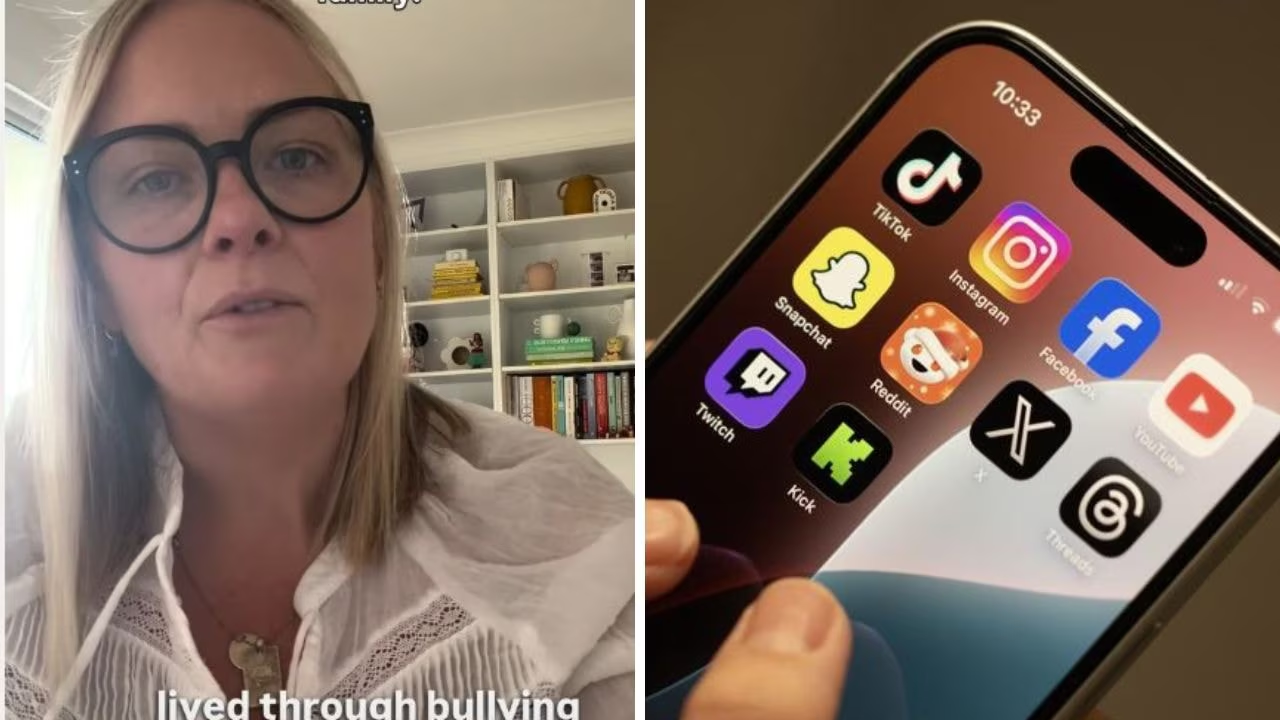
Chantelle Ellem has watched bullying leak out of the screen to tear the fabric of her family’s sense of safety over the course of not just months, but years. “At one stage, my daughter received 100 online messages in one night,” she said.Be the first to know when news breaks. Download our new appMs Ellem’s 17-year-old daughter was targeted so badly – both in person and online – that she was eventually forced to complete high school via distance education for her own safety. Like many parents who find themselves facing the uncharted waters of navigating cyber bullying, she and her husband had assumed there would be a clear course of action for them to take, first with the school, and then with police. “What I quickly learnt was that there are no answers,” she said. “There’s no way forward, and you feel like you’re going crazy because you’re so alone. The school just handballs you and says to go to the police, and the police go, ‘no, you need to go back to the school’… It was like these constant walls of everyone telling us it was someone else’s problem. Mostly, that it was our problem.”60 per cent of caregivers ‘powerless’ against cyber-bullyingA new research report commissioned by Optus shows Ms Ellem was far from alone in not knowing where to turn when cyber-bullying struck her family.The Digital Safety Report showed 60 per cent of caregivers report feeling powerless to stop cyber-bullying, and a staggering 90 per cent don’t know where to turn when it comes to resources to keep their kids safe online. This research also exposed a concerning gap between parents’ ability to manage their kids online safety and what Aussie children are experiencing.The Federal Government’s 2025 Anti-Bullying Rapid Review found that more than one in four students in Years 4 to 9 said they had experienced bullying regularly and highlighted that reports of cyber-bullying have risen by 455 per cent in five years, and over half (53 per cent) of young people in Australia say they have experienced cyber-bullying.“The research highlights that while we feel confident with our own online behaviour, just 40 per cent have confidence in what our kids’ online world looks like from a safety perspective,” explains parenting expert Dr Justin Coulson. “Cyber-bullying is associated with anxiety, depression, school refusal, poor sleep and in the worst cases, self-harm or even suicide.“It’s hard to police because it’s done in secret. It’s relentless. There’s no respite. And despite so much of it being kept secret from adults, it’s easy for it to become astonishingly public to a specific audience – usually the child’s peers. And then the effect is multiplicative. It spreads so fast, and from one school to another until the cyberbullied child feels that everyone knows.”More worryingly, 24 per cent of caregivers say they wouldn’t know where to start looking for digital safety help, 67 per cent have only vague ideas, and just 9 per cent know exactly which resources to turn to. “This was a huge part of the problem for us,” Ms Ellem said. “There is so much I didn’t know, both about what resources are available, and about how you need to show up as an advocate.”Almost half of Aussie parents believe schools aren’t doing enough The new research also found that only 45 per cent of respondents believe Australian schools are doing a good job keeping kids safe online, something Ms Ellem experienced first-hand. “I don’t believe in the school system as much anymore,” she said, explaining she felt forced to switch her daughter from a private school to the local public school when it became clear their response was falling short.“My daughter has ADHD and autism, so we chose a private Catholic school, because they promised so much. They had special days for the orientation, and it just looked so good on paper,” she said. “When the bullying started, I tried all the avenues – calling the school, coming into the office, meetings with teachers. This went on for maybe a year and a half, until (the special needs teacher) said to me, ‘she’s just been stripped of any social status by these bullies. I just don’t think there’s any coming back from this.’ And I just cried in that meeting. They hadn’t fought for her, they hadn’t addressed anything, and we’d just been hitting walls.” While Ms Ellem and her husband initially had high hopes for what a fresh start at a new school might mean for their daughter, the online nature of teen relationships meant she never stood a chance. “Within one week of going to the new school (the bullies from her old school) had spoken to the other kids in the new public school, and they were after her,” she said.“She did not get any reprieve.”‘Getting informed is not enough, but it’s a start’Part of what made Ms Ellem feel so powerless throughout her daughter’s experience was being met with dismissive indifference from both police and schools.“I printed out pages of death threats and took them down to the police station as evidence,” she said. “He didn’t take me into a room to discuss it, just spoke down to me and told me ‘you need to get her help for her additional needs.’”The final straw came when an empathetic police youth liaison officer intervened.“She was amazing,” Ms Ellem said. “We’d go and talk to the parents, who then were like, ‘no, we don’t have anything to do with you.’ The officer would go to the school, and then one day after over a year of all this, she called me and said, ‘I’m at the school. You cannot send her here for one more day. She is broken.’ And so from that point forward, I homeschooled her because I just needed to protect my kid.“The youth liaison officer saying that to me was like that big permission slip I needed to just get her out of there. After that, we did distance education.”The Federal Government’s newly launched Let’s Stop Bullying campaign – created in response to the findings from the 2025 Rapid Review – aims to provide parents with a road map on where to turn to battle cyber bullying. It includes templates to help draft correspondence to schools and law enforcement in order to make sure action is taken, as well as support services and useful resources for parents and kids. “We have spoken to thousands of students and families across Australia who have experienced bullying and seen the devastating impact it has (or, can have) on children,” clinical psychologist and co-chair of the 2025 Anti-Bullying Rapid Review Dr Charlotte Keating said. “The Let’s Stop Bullying campaign will play a significant role in providing the knowledge and tools to help navigate the changing nature of bullying.”Dr Coulson said there were a few “red flag” platforms parents should be particularly aware of.“Riskier spaces tend to share a few features,” he said. “Anonymity, disappearing messages, open direct messaging with strangers, and live chat. Snapchat, group chats on messaging apps, and in-game chat are where many of the problems I hear about play out. Every time I speak with law enforcement, they reaffirm that Roblox is still problematic despite recent changes, so it’s one to definitely stay away from.”Practical tips for parents of children facing bullyingMs Ellem believes the national conversation must stop abandoning families to guess their way through the crisis. “There are a lot of things I wish I’d known, and things I’d do differently if I had my time over,” she says. Chantelle recommends:• Keep a forensic log: Screenshot and document every message, handle, timestamp, and incident.• Demand formal accountability: Set tight timelines with school principals in writing, and insist on official event numbers whenever lodging reports with police.• Know the alternative pathways: Mainstream schooling is not the only route; state distance education providers and flexible TAFE pathways exist without the daily exposure to hostility.Remarkably, despite the trauma her family has endured, Ms Ellem’s empathy for the bullies also remains intact. Along with giving children the tools they need to stay safe online, she argues that real intervention means looking closely at – and supporting – the teenagers wielding the phones.“We have to support the kids being bullied, but I wish people were looking at the bullies as well,” she said. “Not coming at them with a pitchfork, but understanding that hurt people, hurt people. Kids aren’t born evil, any kid has the potential to engage in bad behaviour if they are hurting or searching for belonging. If we actually unpack why they’re doing it and stop sweeping it under the rug, we might finally break the cycle.”Read related topics:Digital Safety
Source link
——————————————————–
Click Here For The Original Source.
