Jess Kern, the executive director and founder of Raindrops Rising Foundation, spoke during the Senate Corrections and Criminal Law Committee on Tuesday.
Cleo Collins told the Senate Corrections and Criminal Law Committee on Tuesday that her 5-year-old daughter was groomed by a child predator—“slowly, deliberately through repeated contact that made her trust someone who shouldn’t have had access to her in the first place.”
Testifying in favor of Senate Bill 119, she said, “Children deserve laws that protect them before they are hurt, not after.”


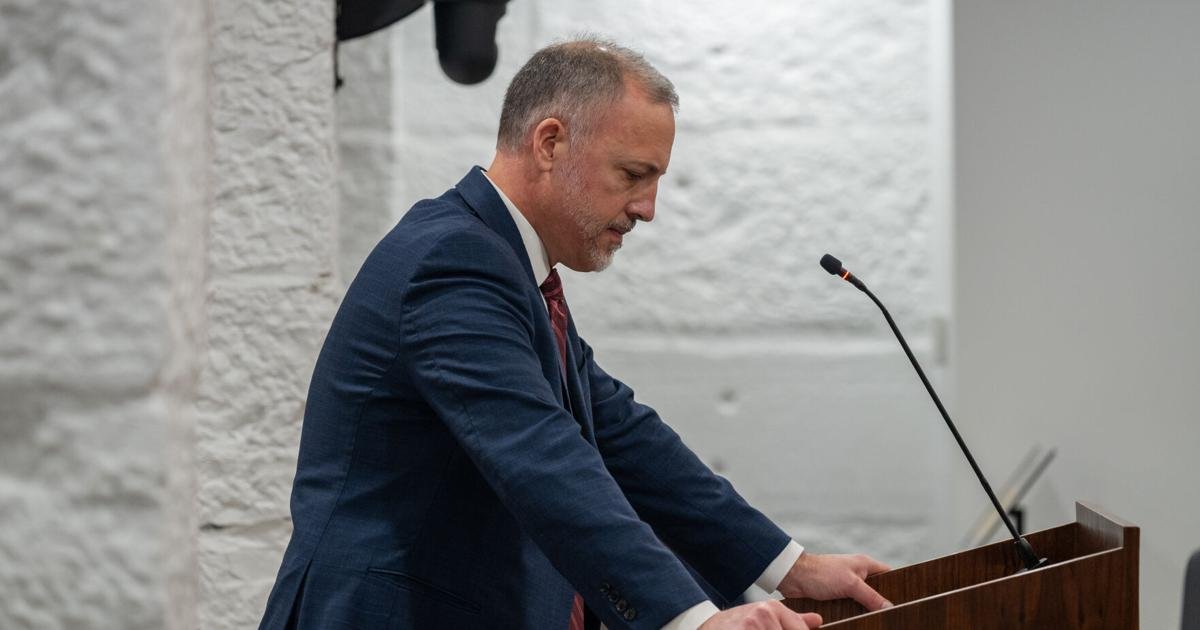
Zach Stock of the Indiana Public Defender Council, in a file photo from early in the 2026 legislative session.
The proposed bill would add facilities and events aimed at children’s entertainment to the list of restricted places where convicted child predators cannot enter or attend, a press release from Indiana Senate Republicans explained. It would also stipulate that if a person repeatedly contacts a child about inappropriate sexual behavior or with the intent to make the child less resistant to inappropriate sexual behavior in the future, that person has committed sexual grooming and will be charged accordingly.
Zach Stock of the Indiana Public Defender Council shared his concerns about what he described as the bill’s broad language.
“Our concern was what does that mean, ‘primarily directed toward a child’? What sort of facility or event is primarily targeted toward a child?” he told TheStatehouseFile.com.
“Is that Chuck E Cheese or … a place like Aqua-Tots?”
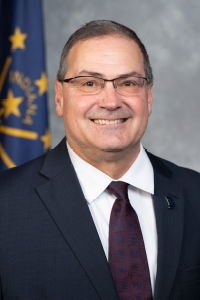
Sen. Dan Dernulc, R-Highland.
Bill author Sen. Dan Dernulc, R-Highland, could not be reached for comment after the meeting, but his press secretary, Kristen Gorski said in an email that Dernulc did not have an example of the facilities mentioned in the bill.
“He is actively working on an amendment to address some thoughts that were brought up in committee that tie directly into that,” she said.
Although the bill raised some concern that it does not explicitly say what facilities would classify as primarily targeted to children, many people shared their support for the bill.
Jess Kern, executive director and founder of Raindrops Rising Foundation, told the committee, “Any anti-grooming legislation such as this bill allows intervention earlier in the abuse cycle, validates survivor experiences, encourages early reporting, and provides prosecutors with the essential tools to stop serial offenders and stop re-victimizations.”
Grooming refers to “intentional behaviors that manipulate and control a child, as well as their family, kin and carers, other support networks, or organizations in order to perpetrate child sexual abuse,” according to the National Office for Child Safety (NOCS).
“Grooming can occur online or in person. Online child grooming is the process of establishing and building a relationship with a child or young person while online, to facilitate sexual abuse that occurs either in person or online.”
At least one in four girls and one in 20 boys in the U.S. experience child sexual abuse, and 99% of child sexual abuse survivors report experiencing at least one sexual grooming behavior.
Evyn Wimer, advocate for Raindrops Rising Foundation, said SB 119 clearly defines grooming as a crime and elevates its seriousness by increasing the penalty beyond a misdemeanor.
The bill passed 8-0 and will now move to its second reading in the Senate chamber.
Amirah Curry is a reporter for TheStatehouseFile.com, a news site powered by Franklin College journalism students.