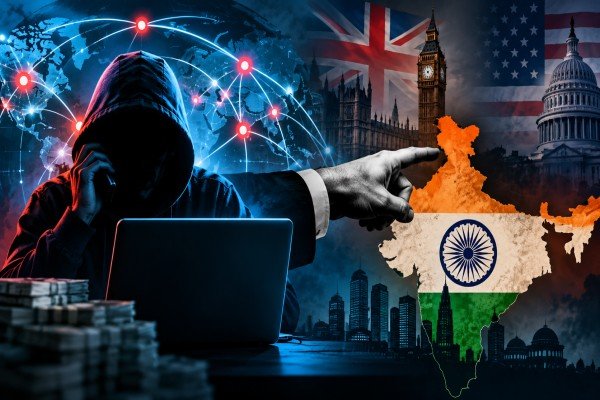
Cyber-enabled fraud has become a major international challenge, threatening consumers, businesses and financial institutions across borders.Yet when victims in Britain or the United States lose money to scams, public debate often focuses disproportionately on the country from which a fraudulent call appears to originate.India, home to one of the world’s largest technology and business-process outsourcing (BPO) industries, has increasingly found itself at the centre of such criticism.Allegations of criminal activity and failures of law enforcement deserve serious investigation. But there is a difference between holding individuals and institutions accountable and portraying an entire country’s technology sector or government as complicit.The international response to cybercrime requires evidence, cooperation and shared responsibility—not the convenient externalisation of domestic failures.Modern financial fraud rarely operates within a single jurisdiction. A victim may be in Britain, a call may appear to originate in India, the digital infrastructure may be hosted in another country, and the stolen money may pass through multiple financial institutions before disappearing into an international network.Identifying the apparent origin of a call does not necessarily establish where a criminal operation is controlled.Investigators must determine who organised the fraud, who controlled the communications infrastructure, where the proceeds went and whether individuals or institutions facilitated the offence.These investigations require cooperation between police forces, banks, telecommunications providers and technology companies operating under different legal systems.Obtaining digital evidence across borders can be slow, while criminal networks can quickly change telephone numbers, relocate operations and exploit gaps in enforcement.India has a responsibility to investigate fraud conducted within its territory. Equally, British and American authorities must examine vulnerabilities in their own banking systems, telecommunications networks and consumer-protection arrangements.A transnational crime cannot be solved by treating it as the responsibility of only one country.India’s emergence as a global outsourcing centre has been one of the defining economic developments of recent decades. Its English-speaking workforce, technical expertise and competitive costs have made it a major provider of customer support, business services and information technology.The infrastructure underpinning legitimate outsourcing—including telecommunications networks, internet connectivity and trained personnel—can also be exploited by criminals. However, similarities in infrastructure do not make legitimate businesses responsible for the activities of illicit operators.Artificial intelligence adds a further dimension. Automation is transforming customer service and administrative work, including activities traditionally associated with outsourcing.These changes raise important questions about employment and economic insecurity in countries with large service-sector workforces.It would nevertheless be misleading to suggest, without supporting evidence, that technological displacement is driving workers into cybercrime.The vast majority of displaced workers do not become criminals. The more defensible conclusion is that technological change creates new vulnerabilities and opportunities that governments, employers and regulators must address.Criminal organisations exploit these opportunities wherever they can. The appropriate response is to identify offenders, close regulatory gaps and protect legitimate economic activity from reputational damage.Rejecting collective blame does not mean excusing failures of law enforcement. India must investigate criminal operations within its jurisdiction, prosecute offenders and cooperate with international partners.India has undertaken enforcement initiatives against cybercrime, including operations by the Central Bureau of Investigation, and has strengthened its legal and regulatory framework.The Telecommunications Act, 2023, and subsequent telecommunications rules form part of its efforts to address the misuse of communications networks. The Bharatiya Nyaya Sanhita also provides part of the wider criminal-law framework within which organised and cyber-enabled offences must be addressed.However, legislation alone cannot demonstrate success.The effectiveness of these measures must be assessed through evidence: criminal networks disrupted, prosecutions secured, assets recovered and victims protected.Telecommunications operators also have a significant role to play in identifying suspicious traffic, detecting the misuse of telephone numbers and responding rapidly to credible warnings.India should acknowledge enforcement shortcomings wherever they exist. At the same time, criticism from abroad should be specific, evidence-based and proportionate. Neither national pride nor international pressure should substitute for a careful examination of the facts.As a scholar of Chinese studies, I have a particular interest in how international narratives shape perceptions of state capacity and legitimacy. Media coverage of cybercrime does not exist in isolation from wider geopolitical relationships.India is an important partner for Western governments, particularly in the Indo- Pacific. Nevertheless, strategic cooperation does not eliminate disagreements over governance, regulation and enforcement.A potential double standard arises when governments are judged differently for similar actions.China’s campaigns against telecommunications fraud networks operating in Southeast Asia, for example, raise legitimate questions about effectiveness, due process and the protection of individuals. Such questions should be asked consistently, regardless of the country concerned.The appropriate standard is neither automatic approval nor automatic suspicion. It is whether enforcement measures are lawful, effective, proportionate and accountable.Western governments should apply the same principles to their own institutions.India, in turn, should welcome scrutiny grounded in credible evidence while challenging generalisations that confuse criminal activity with national character or government policy.This is not an argument that Western media are uniformly hostile to India.Investigative journalism plays an essential role in exposing fraud and holding authorities accountable. The concern is that sensationalist or overly nationalised reporting can make a complex international problem appear deceptively simple.Britain, the United States and India share an interest in protecting citizens from cyber-enabled financial crime. Three areas deserve particular attention.First, faster cross-border investigations. Governments should improve the speed and reliability of requests for digital evidence, telecommunications records and financial information.Existing mutual legal assistance arrangements remain important, but procedures must adapt to the speed at which digital evidence can disappear and criminal networks can relocate. Accelerated processes should retain appropriate legal safeguards.Second, stronger financial cooperation. Banks, payment providers and law enforcement agencies need effective channels for sharing information about suspicious transactions, tracing criminal proceeds and freezing assets where legally authorised.Disrupting the movement of stolen money is often as important as identifying the person who made the fraudulent call.Third, coordinated telecommunications security is critical. Operators should strengthen the detection of spoofed numbers, suspicious call patterns and fraudulent communications.Governments should encourage compatible technical standards and timely cross-border information-sharing while protecting legitimate users and respecting privacy.These measures must be accompanied by better public education, accessible reporting mechanisms and effective support for victims, particularly older people and other vulnerable consumers.Responsibility cannot rest entirely on individuals to recognise increasingly sophisticated deception. Financial institutions, technology companies, businesses and governments must all play their part.The international fight against cybercrime offers an opportunity to move beyond a narrow politics of blame.India has both a responsibility and a strong interest in ensuring that its territory and technological capabilities are not exploited by criminal networks.Britain and the United States have an equally important responsibility to strengthen consumer protection, improve investigations and disrupt the financial systems through which fraud proceeds.Neither side benefits when sweeping accusations undermine legitimate economic relationships or when political rhetoric takes precedence over practical solutions.India should be judged by the effectiveness and integrity of its enforcement efforts, just as Western governments should be judged by their own record of protecting consumers and pursuing criminals.Where evidence establishes negligence or complicity, accountability is essential. Where accusations rest on assumptions rather than evidence, they should be challenged.Cybercrime is a global problem operating through interconnected systems. Its solutions must be equally international.India should be treated neither as a convenient scapegoat nor as a country exempt from scrutiny, but as an essential partner in building a safer global digital economy.
Click Here For The Original Source.
——————————————————–