
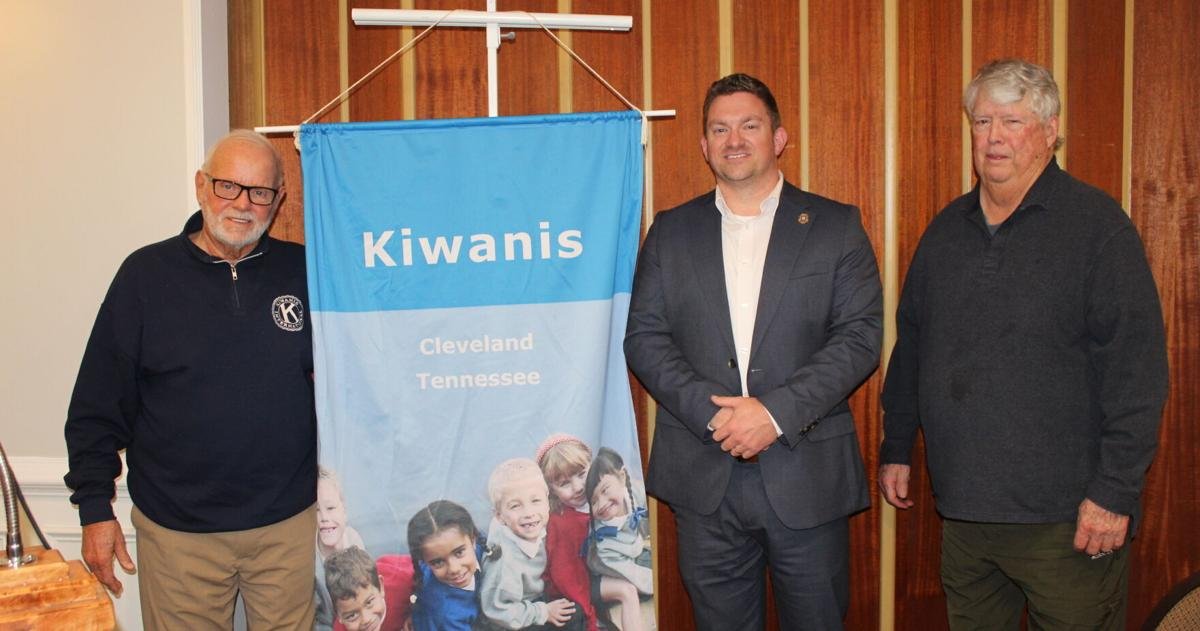
A wake-up call to parents to protect their children from online sexual predators was made during Thursday’s meeting of Cleveland’s Kiwanis Club.
The meeting’s guest speaker was Robert Burghardt, Assistant Special Agent in charge of Internet crimes against children for the Tennessee Bureau of Investigation (TBI).
“I travel all over the state meeting with parents about this,” he said. “It’s a topic that everyone knows is going on but nobody wants to talk about it. I’ve been doing this for nine years, but the problem is getting worse. This is something that our children are facing every day. There are more children online today, and the predators know it.”
Burghardt said federal and state authorities are doing their best to fight this problem by operating Internet Crimes Against Children (ICAC) task forces to catch these sexual predators. There are 61 ICAC task forces operating across the United States.
“All these task forces investigate these Internet crimes against our kids,” he said. “Unfortunately, a lot of what we do is reactive investigations based on the tips we get from the social media companies as well as the calls from the community. I much prefer to do the proactive investigations where we pose as a child online and have the adult predator come to meet us and we arrest them.”
Tennessee has only four TBI agents in its ICAC task force to investigate these crimes and make arrests. Fortunately the ICAC receives assistance from Sheriff’s offices and police departments. Despite their efforts, the scope of the problem is continuing to grow.
The statistics that Burghardt shared on these types of cybercrimes are alarming. In 2020, Facebook reported there were over 20 million cases on its servers of children being sexually exploited. In 2024, other social media companies reported more than 21 million cases. Last year, almost 40,000 cases of Internet crimes against children were reported in Tennessee.
“As law enforcement, we’re just not going to arrest our way through this crime because there are way too many cases and way too many predators online,” Burghardt said. “So, the only way we can go after it is through education. If you spread the message, maybe we can keep our kids safe.”
What is helping to make children more vulnerable to these sexual predators is their use of modern cellphones.
“These phones that they carry in their pockets have more computing power than all the computers put together that put the first spaceship on the Moon,” Burghardt said. “One click on them can change a kid’s life forever. There needs to be more education, more training. If your child has one of these phones, there is a greater chance that they will become a victim of an Internet crime.”
One of the ways that a child can become a victim is having an “online friend” persuade him or her to share a nude photo of themselves. Once that photo is posted, it will remain forever on the Internet.
“Some people will say it’s just pictures and does no real harm,” Burghardt said. “But that short clip or image can become a child’s worst nightmare. It will be shared forever.”
As an example, Burghardt said he knows of a 48-year-old woman who was sexually abused as a four-year old and the video of that rape is still being shared today among sexual predators.
“That woman had a daughter who looked exactly like her when she was a child,” he said. “She still has people come up to her today to ask if she is that child in the video. She’s like a celebrity among the predator community. When people say it’s just pictures, remember those pictures and videos will be shared as long as the Internet exists.”
Another area of child sexual exploitation is “online grooming” where a predator communicates directly with the child on the Internet to get them to send photos and video clips of themselves or to set up meetings. Another aspect of this is what Burghardt called “sextortion” where a predator will threaten to share the photo or video.
“The child’s chat with the predator will turn aggressive,” he said. “The predator will say, ‘Hey, we have your nude photo and we’re going to ruin your life. You need to send us gift cards and/or more images, or we’re going to send it to your family and friends to let them know what you do online.’ Picture yourself as a 12 or 13-year-old kid. Probably the last thing you’re going to do is tell your parents, which is what kids should do. These kids will then walk around school carrying this weight on their shoulders. Some of these kids feel like they have nothing to live for and will end up committing suicide.”
The biggest thing that parents can do to protect their children is to be aware of what they are doing online. If they notice changes in their child’s behavior, it might indicate they have become a victim. If that happens, contact law enforcement.
“Two rules that parents should set for their kids is not to talk to people online that you haven’t met in real life and don’t send anything online that you wouldn’t send to your grandma,” Burghardt said. “If kids do that they will be a little safer. These are also good rules for adults who can also become victims of online sexploitation.”
Convictions for these Internet crimes are “pretty hefty,” Burghardt said. The federal charges will result in a minimum of an eight-year prison sentence. As a TBI agent involved in tracking down and arresting these sexual predators, he said his conviction rate is “very good” because everything they have criminally done is documented online. In McMinn County, a predator was sentenced to 10 life sentences plus 16 years.

